
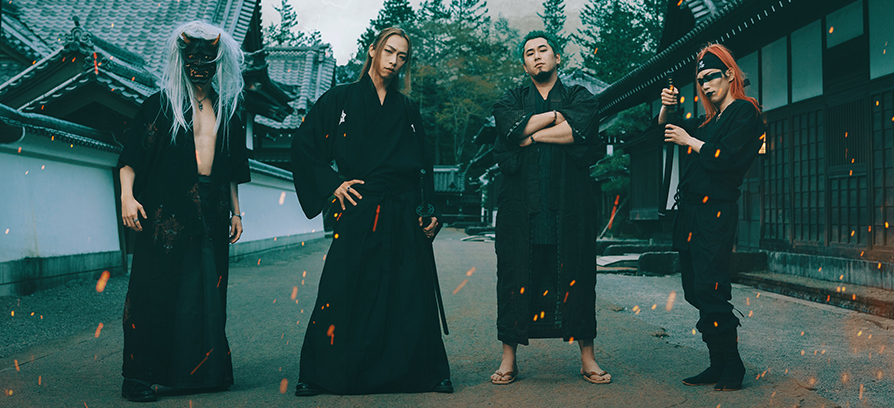
My conversation partner for today has been making music for many, many years. It’s safe to say that he has been playing or at least involved with music for most of his life, spanning several bands. But today, I want to limit our topics to merely himself, and his most recent band, 竜神 (RYUJIN).
However, he can introduce himself a lot better than I can, so I will let him do so first:
“Nice to meet you. I’m Ryuji Shinomoto (篠本竜司), the frontman and composer for RYUJIN. My team calls me Ryo. While my primary roles are guitar and vocals, I also play instruments like the shamisen, erhu and ryuteki during recordings, and I handle all other aspects of the orchestration as well.”
Since Ryuji mentions his team addresses him as Ryo (or Ryoji), and he often credits himself under that name as well, I will follow that trend and refer to him as Ryoji as well during this interview. But, since there is a lot of information, let’s not stall any longer and instead dive right in.
The music that moved me
Ryoji has been making music for the majority of his life, his career involving several bands in the meantime, but that’s something we’ll circle back to later. Let’s start at the beginning…
“While I was studying classical guitar, I was also a big fan of KISS. Even before I ever touched an instrument, I was drawn to the guitar – I’d pretend to play it when I was a kid – and I remember getting goosebumps whenever I heard beautiful music. I played punk during my school days, but as I kept searching for something even more beautiful, I discovered that metal had everything I was looking for.” Ryoji explains. “Sure, there’s heavy stuff out there with very little melody, but my personal taste has always leaned towards the melodic. Plus, it’s incredibly rewarding as a guitarist – I always had this drive to be the best player around!” He adds with a laugh. “Ultimately, the kind of music that moved me before I even started playing is still what I love most today. And I believe that is the true origin of RYUJIN. It was the kind of film music that felt close to classical, often incorporating distinctly Japanese scales.” He finishes.
“It all began with a solo album I released when I was around 18 or 19 years old. From there, I started adding growl vocals to those tracks, which led to the formation of Suicide Heaven. Two years later, that evolved into GYZE – and now it’s RYUJIN.” Ryoji explains. “The message of RYUJIN varies from song to song, so it’s hard to pin down. But I do want to create music that clearly reflects my Japanese identity. Given how much things have evolved so far, only God knows what the future holds…!” He concludes.
“I often draw inspiration from nature, and from concepts like world peace too. In a sense, it’s a worldview brought forth by the ‘ryujin’ (Dragon God). My past works have explored a wide range of themes, including the world wars. I’ve also taken an interest in history and studied it quite a bit.” Ryoji states. “Sometimes, I delve into Japanese religious traditions and incorporate elements of them into my work. The same applies to Hokkaido (北海道). It’s a rather complex place, and until 150 years ago it wasn’t actually part of Japan. The Ainu people lived there, and for that land, we Japanese are essentially an invasive species. That’s why I hold such deep respect for them.”
Fusing East and West
As Ryoji just said, his music contains influences from nature, history and even Japanese religion, but it also combines the musical styles of East and West. In his works you will of course hear the familiar instruments like guitar, bass and drums, but also several traditional Eastern instruments that might be harder to recognize for Western listeners.
“The shamisen (三味線) is an instrument with three strings, shaped somewhat like a guitar. It is indispensable to Japanese folk music and perfectly suited for percussive, high-energy passages. I’m pretty sure I was the first person to fuse shamisen with metal music.” Ryoji states confidently. “The erhu (二胡) is a Chinese instrument with two strings, played with a bow – much like a violin. It’s one of my favorite instruments in terms of it’s timbre, its sound is very close to the human voice, possessing a soft, feminine quality.” He continues. “The ryuteki (龍笛) is an instrument used in ‘gagaku’ (雅楽), a traditional form of Japanese court music. It is typically played alongside other instruments, specifically the hichiriki (篳篥) and the shou (笙).” He explains patiently. “To draw a parallel to Western instruments, you could think of the ryuteki as a flute, the hichiriki as an oboe and the shou as a kind of miniature pipe organ. I highly recommend listening to ‘Etenraku’ (越天楽), one of the most iconic pieces in the gagaku repertoire.” Ryoji suggests, before continuing: “As for the taiko (太鼓), think of it as a wooden floor tom! I even played one at school back when I was in elementary school.” He concludes with a smile.
While Ryoji is the most prominent member of his projects, he’s not the only one playing music. He might be the one doing the majority of the composing, but he’s not on the stage or in music videos by himself all the time. In RYUJIN he’s accompanied by his younger brother Shuji on drums, Aruta on bass, and one mysterious character…
“Shuji and I are brothers who are only one year apart, and we’ve always been together. So it was natural for us to form a band together. He also has a great ear and is very talented in music. There’s no need for pointless discussions because the points that move you in music are close together. I sometimes compose music based on requests from them! If he thinks something is wrong, he will let you know. Their opinions can sometimes improve the arrangement of a song!” Ryoji says. “Back when we made our previous album “Asian Chaos”, Shuji had left the band. So we created a person called ‘Hannya’ (般若) to fill his spot. If we had simply brought in another actual member, it would have been more difficult for Shuji to return, right? That’s why we introduced this fictional character.” He explains. “And now, with our former guitarist having left the band, Hannya has made a reappearance.”
It’s not just his music that fuses East and West into something instantly recognizable as Ryoji’s works, but his music videos are often a mixture of both as well. And the same can be said about the lyrics.
“I’m sure that the message in my music videos is getting across. Traditional Eastern culture is completely different from that of the West, so there is a major contrast in terms of visuals too. That said, I get the sense that many Japanese people don’t necessarily view things that are ‘Japanese’ as ‘cool’. Especially in a scene like metal, there is a tendency to believe that being ‘Western-style’ is what makes something good… Since we happen to come from a country that is a minority in the global metal market, I want to keep sharing our own unique, original identity!” Ryoji explains.
“I choose Japanese when it fits the music better, and English when that feels more natural. The reason why there are two versions of the song “Saigo no Hoshi” (最後の星) on the album “RYUJIN” is that I wanted to reach the audience in both languages – and also because Matthew’s version was so wonderful that I simply had to include it! The lyrics are a bit sad, and I wanted people to be able to enjoy both versions. Beyond that, I wanted to show how much the impression of a song can change depending on the language it’s sung in and who’s singing it.” He concludes.
Wow, wow, hold up! You’re going a bit faster than I hoped you would. We will return to the RYUJIN-album in a moment, since there is a lot to tell about it. Let’s talk about the band RYUJIN instead to give everyone a bit more background information first.
Japanese style metal: Samurai Metal
“RYUJIN uses the simplified character for ‘ryu’ (竜 instead of 龍) – a simplified version of my real name, Ryuji. As I mentioned earlier, this project has been a solo endeavor from the very beginning, and even now, I typically create all the parts for the tracks by myself.” Ryoji starts.
“You’re right.” Ryoji continues. “The pronunciation issue with GYZE has been weighing on me for a long time. Plus, after a hiatus due to the pandemic, it felt like the perfect moment for a fresh start. Matthew also agreed that changing the name was a good idea.” He adds. The ‘Matthew’ he is referring to is Matthew Kiichi Heafy, probably most known for his work as the vocalist of Trivium. Matthew is a very big part of the RYUJIN album, but we will circle back to that in a moment. “Since I’m the one composing the music, the band name itself isn’t a major issue for me. That being said, GYZE has a 10-year long history, and I’m very proud of that. That’s why I’ve kept the ‘G’-emblem.” Ryoji explains. And since I know a lot of people who are reading this aren’t Japanese, ‘GYZE’ is pronounced as something close to “gii-zeh”, and not “gaiys” for example, which is what Ryoji is referring to with the ‘pronunciation issue’.
“I chose the name RYUJIN because it fits our Japanese style metal sound, and more importantly, it is a term that has been part of my life for a long time. It was also something Matt suggested. It might sound a bit strange, but people with a spiritual perspective have often told me: ‘you have a dragon with you’. Also, in Eastern culture the number 8 is associated with dragons – and my birthday happens to be November 8. I took that as a sign of destiny, and that’s how it became RYUJIN.” He concludes.
“For this next album, I worked with an American engineer for the first time. A guy named Mark Laws! The sound is different from what I’ve done in Europe, but he did a fantastic job. I had long chosen to work with European engineers, partly because Europe is the birthplace of classical music; I felt they would be able to craft something precise and beautiful. That said, I handled the mixing and mastering for all the singles between 2021 and 2022 – tracks like “Samurai Metal” (サムライメタル) and “Oriental Symphony” myself. The number of tracks had simply become too high, making it increasingly difficult for anyone other than me to manage them…” Ryoji admits.
“RYUJIN” is being released through European-based metal oriented record label Napalm Records, which is quite the achievement. Please tell us more about it, Ryoji!
“I don’t want to be misunderstood, but I no longer have any expectations for Japanese companies. Even as the world began shifting to digital, Japan remained fixated solely on selling CDs, and focused exclusively on promotions in the Japanese language – yet they still utilized global platforms like Spotify and YouTube, while keeping everything in Japanese.” Ryoji explains, something that you can confirm for yourself. It’s not universal, but a large majority most certainly focuses on promotion in Japanese, and not just in the metal-genre either…
“For a long time, Napalm Records has been my favorite label. Their roster is always cool, and they are an indispensible force in the global metal market. That’s why I am so proud that we – as the first Japanese band to do so – were able to sign with Napalm Records under the banner of ‘Samurai Metal’. Furthermore, because it’s a European company, I believe it will endure – much like classical music has – for the next 200 or 300 years, even if it evolves into new forms. In short, because they come from a culture that has always cherished music, I am confident they will continue to value it well into the future. I believe it’s truly significant that ‘Samurai Metal’ will remain a part of Napalm’s history – not just for now, but even long after we are gone.” He states.
“What I’ve often thought is that I want us to operate just like bands elsewhere in the world. In Japan, there is a tendency to draw a sharp line between the domestic scene and the rest of the world, treating overseas shows as something exceptionally grand or special. While those performances are certainly important, the truth is that playing in any country is significant.” Ryoji explains. “As for the performances themselves, it’s harder to generalize, as reactions can vary from one country to another – even within Europe. That said, my goal is always to give it my absolute best; I believe it’s crucial never to hold anything back.” He finishes.
Self-titled album “RYUJIN”: Everything fell into place
I think I’ve held you back long enough. Let’s finally discuss the first album of RYUJIN, its self-titled work “RYUJIN”!
“A major highlight is that the album was produced by Matthew – he handled everything from song selection and choosing the mix engineer to the artwork!” Ryoji starts with great enthusiasm. “He took a particular interest in my clean vocals, so I ended up singing much more than I have in the past. The album also features our first-ever ballad, as well as a pop-power metal track – songs that likely wouldn’t have made the cut if he hadn’t been the producer. And, as I mentioned earlier, working with an American engineer for the first time gave the record a fresh, new sound.” He continues. “Everything fell into place quite naturally! As we were discussing the tracks, we’d say things like ‘I’ll sing this part!’. The original concept for “Raijin & Fujin” came from Matt, so it was only natural that he would sing it!” He continues enthusiastically. “There are two versions of “Saigo no Hoshi” – one in Japanese, which I sang, and another in English, sung by Matthew. It turned out absolutely fantastic!” Ryoji concludes, his enthusiasm being very contagious.
“Working with mister Mukai also happened very naturally!” He continues, referring to Wataru Mukai (向井航), the principal cellist of the Kansai Philharmonic Orchestra. “Since I had originally included a cello sample in “Saigo no Hoshi”, I asked him if he’d be willing to play it live – and he did! As for the song “Kunnecup”, mister Mukai actually requested to play on that one himself! It seems it was a track that really resonated with his personal taste!” Ryoji concludes, giving us some more insight in the collaborators we can hear on this album.
“Actually, “The Rainbow Song” wasn’t written for the band; I composed it for personal reasons. Because of that, I really struggled at first with how I wanted to make my vocals fit. I tried out many different ways of singing, and Matthew helped me choose the best approach…” He says with a smile. “I’m definitely better suited for growling, but the fact that I can also sing with clean vocals could really change things for the future. So, if the need for clean vocals ever arises again down the line, I’ll certainly be open to singing them!” He concludes, the smile still on his face.
The album also includes a cover song, namely “Guren no Yumiya” (紅蓮の弓矢) by Linked Horizon – the opening theme for the very popular anime series “Attack on Titan” (進撃の巨人).
“This song was another one of Matthew’s requests! Apparently he’s a huge fan!” Ryoji answers. “I’m a bit embarrassed to admit it, but I didn’t even know about it until he told me.” He adds with a laugh. “Still, it’s a really great song, and I had a lot of fun with it!”
Currently, the self-titled album from RYUJIN is available in Europe via Napalm Records, but what we often see is that a non-Japanese label covers the rest of the world, but Japan gets its own version of the release. Is this the case for “RYUJIN” as well?
“I believe there will be a release specifically for Japan! But to be honest, I’m not really involved in that – I’ve left it up to my manager and the label. That said, I’d personally love for you to get your hands on the original Napalm Records edition!” Ryoji answers. Napalm Records often includes special bonuses with their releases too, so it’s always worth checking it out!
Things will keep evolving
We’ve spoken a lot today! But I’m not your main source of information, so where can you keep up to date with Ryoji’s next steps?
“Social media is certainly convenient, and I suppose that is what people get their information these days, right? Things will surely keep evolving as time goes on, so I’m not entirely sure how best to answer that – but regardless of the method, I’m just happy that you are thinking of us!” Ryoji replies. You can find him on Facebook, Instagram and X though, more on that in a moment!
We’re almost at the end now, and I’ve been bombarding Ryoji with questions this entire time, but along with his parting message he also has a question for you, the readers:
“Thank you so much for sticking with me until the end! I’ll do my best to make it to your city, so I really hope to see you at the venue when that happens! But, what kind of music would you like to hear from us in the future?” And with that, Ryoji concludes today’s interview.
___
I really hope that you’ve enjoyed Ryoji’s in depth answers to my barrage of questions for him. It’s quite rare to speak with a musician so openly about topics that might hit a (wrong) nerve with some people, and of course their creative mind as a whole. The only thing I can say more is basically an echo of what Ryoji already told you: the new album “RYUJIN” is available for streaming through Spotify and Apple Music, and a physical CD as well as an orange vinyl version are available through the webshop of Napalm Records – this latter being the ‘special bonus’ mentioned earlier.
More about 竜神 (RYUJIN):
 (RYUJIN)          |  (Ryuji) |  |  |  |