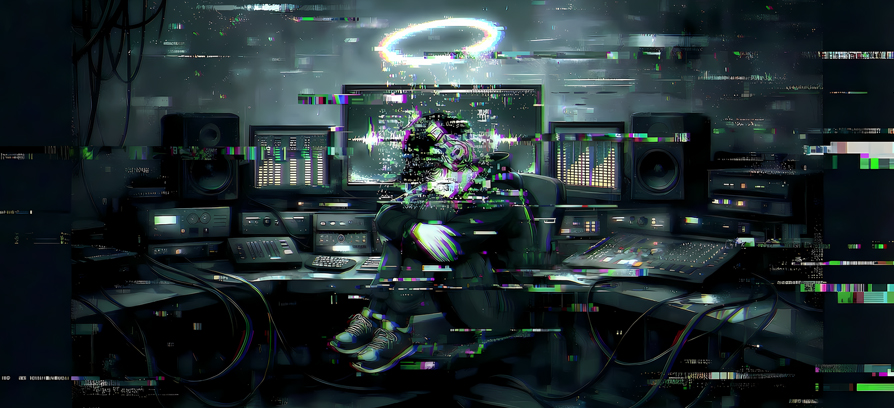
Ryo Trackmaker, or just Ryo, is probably the most recognizable as the drummer of the now inactive band girugämesh. And while the band ceased activities ten years ago now, Ryo has occasionally shown up with a cover song on YouTube, or as a collaborator on the releases of other artists. And you’ve probably seen his new work that he started in early 2026…
“I’m Ryo Trackmaker. I’m a solo artist who creates music, sound, videos and even stories as a single design. I chose the name ‘Ryo Trackmaker’, because rather than being a performer I’m in a position where I design works that include music, video and story. The greatest freedom I’ve gained from going solo is being able to decide everything from the genre and production method to the choice of voice in the best way for each work.”
Though today, Ryo describes his project as an original music x visual project, rooted in modern metal and dark pop, but also having elements of alternative rock. For this project he takes on everything by himself, from the songwriting, guitar recording and vocal design to the mixing and sound building with the help of Synthesizer V and SUNO – which we can see in his first release “REGENERATE”.
“REGENERATE” was released on February 3rd of this year, and embodies everything previously mentioned. But it also sparked quite an intense response online, which intrigued me. The use of AI in music is controversial at best, but I also immediately felt like there was a story to be told here.
Before we dive into today’s interview I want to warn you that this is going to be one of my longer articles, due to the subject matter and how much Ryo explained me about his creation process.
So strap in. We’re about to go on a ride, together!
—
“The past ten years have not been a time to step into the public eye, but rather a time to reorganize my way of making music and my way of thinking. While the way I make music, the tools I use and the forms of expression have all changed dramatically, I finally felt like ‘now is the time to release my music in the way I really want to’. Which is why I came back at this time. “REGENERATE” is the first work that symbolizes this restart.”
Ryo’s first song “REGENERATE” was released on February 3 of this year, and you may even have noticed some of the discussion going on during the time of its release. “I expected this type of response to some extent. The voice is the element that is most connected to emotions, so it’s natural that any change would provoke a strong reaction.” Ryo says, since the vocals for this song (and also the songs that have followed in the meantime) were not done by Ryo himself. Or even a real person. Ryo makes use of SUNO and Synthesizer V to create his works, which means that yes, he is using AI to generate the vocals you hear in his songs. “But to me, the voice is just an instrument among many. I simply chose the sound that best suits each piece, so it wasn’t a particular surprise. In fact, I see the fact that it sparked a debate as proof that my work has been properly received.”
“To me, AI is not something special, but rather a normal production tool. Just like synth or DAW, I see it as one of the means to achieve expression.” Ryo explains. “The important thing is not whether to use AI or not, but rather to first think about what you want to create. If your purpose is clear, then use it. But if it’s not necessary, then don’t use it. Ultimately, I believe the responsibility for the work lies with the creator, not the tool.” He continues.
“The one thing I want to convey is that I don’t make music to be bound by genre or method. I will continue to create worlds, choosing the best form for each piece. If you come across a fragment of that somewhere, please check it out for yourself.” He adds, giving us a small glimpse of his view on the use of AI in music. But was the use of AI by chance, or was it something decided on purposely to aid in achieving what he imagined?
“No. “REGENERATE” wasn’t a song that came about by chance during production. I had decided on the direction of my first solo song from the beginning. I had the overall picture designed from the very start, including the theme that symbolizes my restart, the strength of the sound, and the structure that would serve as the entrance to the worldview. Then I worked out the details as I was producing it.” He explains, meaning that every step he took was intentional, and nothing came about ‘by chance’, as you often see with AI generated works.
“I should point out first of all that I don’t leave the voice creation to the AI from the beginning. I design everything from the melody, notation, lyrics and intonation using Synthesizer V, and then adjust the final voice quality based on that finished product. So during production I hardly ever get the feeling that ‘the AI did something unexpected’. Basically I’m just refining what I’ve designed to make the texture suit the piece better.” He continues. “I used AI vocals for this song, not because I wanted a female voice, but because I wanted to maintain the key and musical expression I had initially decided on. I created the melody and vocal design first using Synthesizer V, but while it can create accurate designs, it cannot perfectly create emotional texture. So ultimately I used AI to complete the emotional nuances needed for the song. For me it’s not about the type of voice, but the process of achieving the expression needed for the piece.” He says, explaining in detail why his decision to use an AI program to add to his work became such a prominent part of the final product we can hear now. The starting point, unlike some music we can unfortunately find on services like Spotify nowadays, wasn’t AI. For Ryo’s work it’s merely a tool to help create a physical form of what he has in his head.
“AI was mainly useful in the process of adjusting the texture and the nuances of the voice, but the core of the work was created by a human. To me, AI isn’t something that creates on my behalf, but rather a tool to help me complete what I’ve designed.”
“REGENERATE” makes use of both Japanese and English lyrics, but something that stands out compared to a human vocalist, the AI sounds very natural in both languages. Where a human tongue is limited by the Japanese language as a native speaker, the AI doesn’t struggle with this ‘problem’. This isn’t important for the main topic we’re discussing today, but it was something I immediately noticed when first listening to Ryo Trackmaker’s first release.
“I choose languages not because of a specific target audience, but because of the sound. For each phrase I use the language that conveys the emotion and rhythm most naturally. There are parts where English suits the sound and rhythm better, and there are parts where Japanese allows me to express more subtle emotions. Using both languages felt natural in my songs.” Ryo explains. “Rather than referencing the past, the lyrics of “REGENERATE” describe the moment when something that was once broken rises up of its own volition. After a long period of silence and change in circumstances, the song’s core is the determination to reboot on one’s own, rather than being saved by someone else. What I want you to hear in this song is not a sense of ‘going back’, but a sense of ‘being reborn in one’s own form’.”
““REGENERATE” is not a one-time release. I’m already working on my next project, and I have no plans to stop. I see this project as something that will continue, building up a world one song at a time. I’m sure you’ll continue to listen to new work in the future.” Ryo already followed up on this statement with his second track “TOXIC”, which was released on March 13, “A SCREAM TO BE MYSELF” released on March 29 and “CLEAN HANDS” on April 24.
So it’s clear that the world of Ryo Trackmaker is growing. One song at a time.
While I have asked Ryo a lot of questions during this interview to get a very clear visual of his creation process, he did have a question he wanted to ask all of you reading this today: “If I could ask one thing, I’d like to know if when you listen to music, you judge it not by genre or method, but how it makes you feel. I value that as the only thing I care about when I create, so if you feel something, I think that is the answer.”
Additionally, he also has a message for everyone who stayed with us during this long interview today: “Thank you for reading this far. I will continue to create worlds without stopping, so if you hear my music somewhere, please listen to it for yourself. From that moment, this world begins.”
—
I want to echo Ryo’s words slightly, and thank you for taking the time to read today’s interview, especially because it was so long. I would also like to thank Ryo once more for taking the time to speak with me and explain his creative process, opinions and ideas as clearly as he did. I hope I could convey some of it to you, and that you see his music in a different light than you might have before. Since the second I saw the discussion I felt like there was a lot more to it than was being said at that moment.
If you’ve gotten curious enough about his next works… You can find his music on YouTube, Spotify and Apple Music (all linked below).
More about Ryo Trackmaker
        |